The Seven Habits
What makes for healthy interpersonal relationships? Healthy relationships are based on the principle of cooperation. As I thought about this and how it might be helpful to different people in different contexts, for example, work, family, The Seven Habits Flew off my bookshelf. The section that dives into interpersonal relationships basically holds selfishness accountable for a lack of cooperation amongst people. Apparently, the faulty thinking and behaviour stems from a flawed Paradigm. What’s needed here is a shift in thinking or a Paradigm shift that goes from one end of the continuum of selfishness to the other end of the continuum of cooperation.
According to Covey, the people are not the inherent problem, but the Paradigm is at fault. Upon analysis and exploration, what was discovered was a system based on selfishness and a resistance to cooperation and a defensive style of communication. This can also extend into the topic of how defensive behaviour manifests itself externally, with a tense closed off posture where whatever message is being sent is sure to be ill received or not received at all. There is an overall resistance to some perceived authority. This climate is one with low levels of Trust stemming from an atmosphere of competition and not cooperation. There is no quick fix or technique that will magically get people to cooperate with each other. Instead, what is most effective is a shift in Paradigm where cooperation becomes a value embedded at the core thinking level and starts to change the overall climate. Focusing attention on producing personal and overall excellence is more effective and long-lasting than trying to make changes at the level of overall attitude and behaviour.
It appears that what is most beneficial is thinking in a more lateral way rather than in a hierarchical way. In this respect it doesn’t matter if you’re the president or if you’re the janitor. What links everyone together is the shared interdependence. The moment there is a shift from independent thinking to more interdependent thinking true leadership emerges. Herein lies the added potential of having a positive influence on others. This climate or atmosphere creates a win/win situation which is the best possible outcome for all.
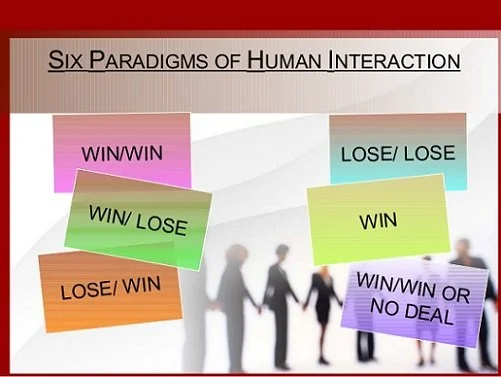
The six paradigms are the following:
Win/Win: a total philosophy of interaction that seeks mutual benefit in human interactions. Solutions are mutually satisfying. In win/win situations, everyone feels committed to the action plan in the spirit of cooperation and not competition. There is no dichotomy such as strong or weak, and there is no competitive arena. The philosophy here is that there is plenty of success to go around and one person’s success does not exclude the success of others. It’s not your way or my way but the better way. Feeling successful leads to enhanced self-esteem and self-confidence.
Win/Lose: This is an authoritarian model. These type will use positions, titles and credentials or their personalities to establish themselves. It seems that many people subscribe to this belief system which has been embedded in their mindset over the long term. Examples include comparing different children in a household to each other. Love and patience are withdrawn, and the people think they’re flawed or lack real value. It is conditional. It is based on external expectations. Academia and sibling rivalry can reinforce this toxic mindset. Grades open or shut doors. Life is not a competition. If both people aren’t winning in the end, they are both losing. Life is based on interdependence. The best results come from cooperation. The Win/Lose mindset is dysfunctional at best, at worst, it is toxic.
Lose/Win: This mindset is worse than Win Lose as it has no standards. This type seeks to appease to the point of self-effacing behavior. These types have a hard time expressing their own feelings and needs and want to maintain an atmosphere of peace but sometimes to their own detriment as they can disappear and no one barely notices them. They are permissive and easily intimidated by others. Win/Lose types often take advantage of Lose/Win Types. They are total opposites. Lose/Win Types are great at stuffing their emotions. Problems manifest later in the form of medical diagnoses, outbursts of anger from not having dealt with problems as they arise, cynicism and overreacting when feeling provoked. Suppressing feelings crushes self-esteem and self-confidence and effects the overall quality of relationships.
Lose/Lose: These types of win/lose types get together and in the end they both lose due to their stubbornness and being ruled by their ego. They can become vindictive and try to get even. Divorces can sometimes end in lose/lose scenarios with a partner interested in getting even or making their ex-partner uncomfortable in many ways. This can be traumatic. Highly dependent people who lack an inner sense of direction can get caught up in lose/lose scenarios.
Win: These types are concerned with their own gains. In essence, there is no competition but there isn’t any cooperation either. They are seeking to secure their own ends and others should do the same. Hence the expression, every man for himself.
Which is Best?
The answer is that it depends on the situation. Clearly, competitive sports operate on the win/lose paradigm. Lose/win can also be useful when the relationship is more valued or prioritized over the outcome for the sake of affirming the other person. The decision as to which is most effective depends on the context of the situation. Most situations require interdependence and taking the approach of a win/win situation leads to the most favorable outcome for everyone involved. Focusing on a win only mindset doesn’t foster any relationship at all and does not take another’s point of view into consideration. Not the best choice in most situations unless a person’s life depends on it.
Last but not least:
Win/Win or No Deal. It either ends in a favourable outcome for both of us, or we walk away from the whole thing and agree to disagree.
the people are not the inherent problem, but the Paradigm is at fault.